
The Ohio EPA Emergency Response division receives over 5,000 calls annually, reporting incidents that mostly involve hazardous materials. This alarming number indicates the need for professional biohazard disinfection and decontamination services in Ohio. But before you call in the experts, it’s important to understand which biohazard decontamination Ohio methods are approved, effective, and commonly used across the state. Here we’ve enlisted all of them.
9 Approved Biohazard Decontamination and Disinfection Methods in Ohio
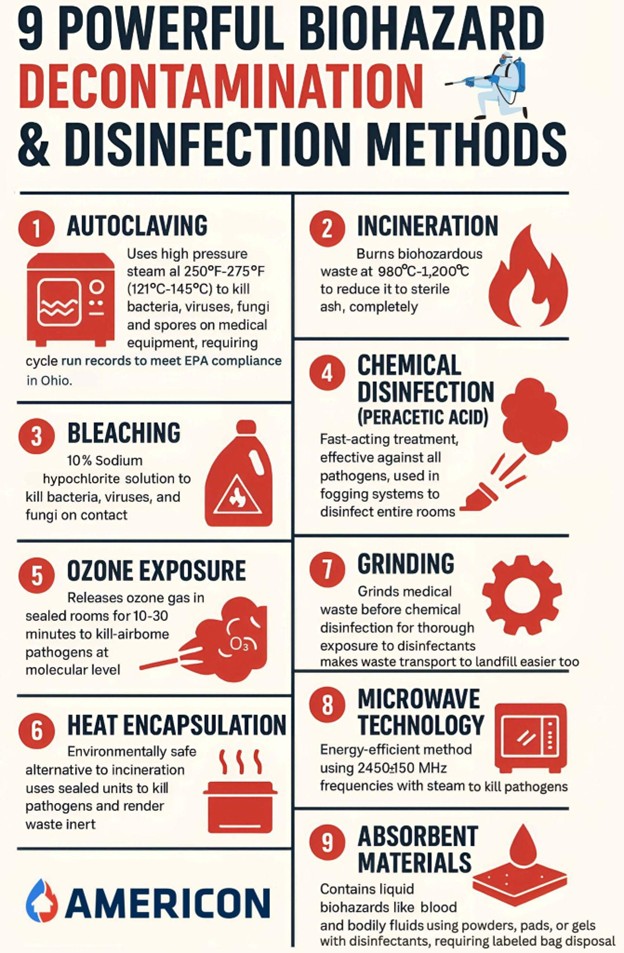
As per regulations by the Ohio EPA, the approved treatment methods for biohazardous waste include autoclaving, incineration, chemical treatment using hypochlorite or peracetic acid, and ozone exposure. Other methods might include heat encapsulation, grinding, microwave technology treatment, and using absorbent materials for spills.
Here’s a detailed understanding of these methods, how they work, their benefits, and which area each method is suitable for.
1. Autoclaving
Most commonly used in medical and laboratory settings, autoclaving is an EPA-approved treatment for biohazard decontamination and disinfection. This treatment uses high-pressure steam at temperatures of around 250°F to 275°F (121°C-135°C) for a minimum time recommended by the autoclave manufacturers. It kills harmful bacteria, viruses, fungi, and spores on items placed inside the autoclave machine (like PPE, culture plates, and reusable instruments).
Virus and bacteria cleaning experts use this method to disinfect contaminated lab tools, glassware, and surgical instruments. And they’re required to maintain a record of every cycle run to meet Ohio EPA compliance.
It’s a standard chemical-free treatment used in clinical facilities where safety protocols are strict. However, the downside of this method is its inability to handle large-scale solid waste. It’s only suitable for batch processing.
2. Incineration
At crime sites or unattended death scenes, the incineration process is widely used. It’s a process where biohazardous waste is burnt at extremely high temperatures (980°C-1,200°C) to reduce it to sterile gas, ash, and heat. Disinfection and decontamination services Ohio use this effective method quite often to deal with highly infectious wastes, such as blood-soaked tissues, sharp objects, or contaminated PPE.
The Ohio EPA regards this method as one that completely destroys all pathogens and hazardous agents. Commercial sanitization services Ohio use this method to get rid of bulk waste material that is hazardous and not reusable. However, it’s a highly regulated treatment that requires professional presence to meet environmental standards and obtain required permits.
Also, this treatment can only be done in a medical facility where incineration is permitted. Cleaning professionals need to transport hazardous materials safely to these facilities.
3. Bleaching
Bleaching is another highly recommended treatment used by the disinfection and decontamination services Ohio. It’s a chemical treatment used to disinfect non-porous surfaces in residential and commercial places. Though easily accessible, it should not be taken lightly as a 10% bleaching solution (Sodium Hypochlorite) can kill bacteria, viruses, and fungi on contact.
The chemical in this solution works by breaking down cell walls and denaturing proteins to effectively neutralize pathogens. But you should prefer not to come in direct contact with this chemical and let the professionals handle this treatment, as it can irritate skin or lungs and needs proper dilution and dwell time.
This method is the go-to for commercial sanitization services Ohio to decontaminate nursing homes, gyms, and restaurants.
4. Chemical Disinfection Using Peracetic Acid
Another EPA-approved method virus and bacteria cleaning experts use is chemical disinfection using peracetic acid. It’s a powerful, fast-acting treatment that’s effective against bacteria, viruses, fungi, and spores. The best part about this treatment is that one doesn’t have to use the manual wiping method.
Peracetic acid is widely used in fogging systems, where this chemical is sprayed as a fine mist across the entire room, and it stays there for a while before the room is thoroughly ventilated. This way it kills all the airborne pathogens, plus those on the surfaces. It’s an ideal method for cases like COVID-19. The cleaner won’t even touch anything infectious, but still disinfects the entire place thoroughly, even those hard-to-reach corners.
Moreover, this disinfecting method is used for both solid and liquid waste streams; however, it is used in a controlled environment. Only professionals should use this method to decontaminate and disinfect biohazardous waste, as PAA in high concentrations can be corrosive, and it needs OSHA compliance protocols.
5. Ozone Exposure
Ozone exposure is one of the most commonly used biohazard decontamination Ohio methods. Commercial sanitization services Ohio use this method for odor treatment and for the killing of microorganisms at the molecular level. It works by releasing the Ozone gas in a sealed room and leaving it for some time there (around 10 to 30 minutes). This EPA-approved treatment leaves no chemical residue behind and oxidizes itself to become environmentally safe.
This is a powerful method to kill airborne pathogens, like viruses or bacteria. Professional cleaning services in Ohio use this method to decontaminate and disinfect HVAC systems after an accident or to clean ambulances, cleanrooms, and hotels or offices.
Keep in mind that Ozone exposure is toxic in high concentrations, and it should only be handled by EPA-certified professionals.
Note: Due to the toxic effects of ozone, the place must be evacuated before ozone exposure. Every living thing, including people, pets, and plants, should be moved out, and re-entry should only be made after thorough ventilation.
6. Heat Encapsulation
As mentioned by the Ohio EPA’s infectious waste regulations list, heat encapsulation is an approved biohazard decontamination Ohio method. It’s an environmentally safe alternative to the incineration method, as the process happens in sealed units while killing most of the active pathogens and leaving the waste inert.
Being part of the industrial disinfection solutions Ohio, this is an effective method for biohazardous waste that cannot be disposed of without treatment, and transporting it before treatment is a risk as well. So you need an on-site treatment that decontaminates and disinfects the biohazardous waste before disposal, which is the heat encapsulation method.
Biohazard decontamination professionals use this treatment in industrial and manufacturing settings, where sharps, chemical residue, and hazardous dust need secure containment. However, keep in mind that as this method requires specialized equipment handling only EPA-certified professionals should perform this method.
7. Grinding
Grinding is another approved biohazard disinfection and decontamination treatment in Ohio. Most often, this method is used with other treatments like chemical disinfection, for the safe treatment and disposal of biohazardous waste. In this method, medical waste products are ground before being exposed to chemical disinfectants.
This allows for the thorough exposure of waste products to chemical agents, which is necessary for effective disinfection treatment. Plus, it makes the waste easy to transport. Then, cleaning professionals can dispose of this waste material in landfills (in case it’s solid) and sewer systems (in case it’s liquid) without any worries.
Moreover, as per the reports, the U.S. produces over 3.5 million tons of healthcare waste annually, signaling a higher demand for this grinding and chemical disinfection treatment.
8. Microwave Technology Treatment
Microwave technology treatment is another safe and energy-efficient alternative to the incineration method, making it one of the most powerful biohazard disinfection and decontamination treatments in Ohio. As part of the industrial disinfection solutions in Ohio, it’s best suited for large hospitals, pharmaceutical manufacturing plants, bioresearch waste, and private biohazard waste disinfection and decontamination.
This method works by reducing the waste into shredded pieces, adding water to it (for the necessary steam environment), and then heating this moistened waste (using frequencies around 2450 ± 50 MHz and 915 ± 25 MHz) under controlled conditions to kill all active pathogens, including bacteria and viruses. Then, in the end, you get a solid residue that’s safe to dispose of in regular landfills, and no toxic emission is produced as well.
Additionally, this method is also approved by the World Health Organization, provided some specific disinfection performance standards are met.
9. Using Absorbent Materials for Spills
Virus and bacteria cleaning experts in Ohio use this powerful method to disinfect and decontaminate light biohazard waste smartly. It’s a very effective way to contain and neutralize liquid biohazards on-site. Professionals spread these absorbent materials over spills like vomit, blood, bodily fluids, or chemicals to control these spills and later dispose of them safely.
These absorbent powders, pads, or gels sometimes even contain disinfectants or pH neutralizers to start disinfection and decontamination on-site. It’s a huge part of the industrial disinfection solutions Ohio to deal with industrial leakages and chemical spills. Moreover, this method is also effective for crime scenes when dealing with large amounts of blood.
However, these materials need professional handling, and they must be disposed of in labeled bags as per Ohio EPA regulations. According to a biohazard spill response guide from Oregon State University, manual handling of the absorbent material once biohazard waste is absorbed increases the risk of contamination, so it must be dealt with using scoops and biohazard-labeled bags.
Can items be disinfected without being cleaned?
Items cannot be effectively disinfected without first being cleaned. Cleaning removes dirt, debris, and organic matter that protect microbes from disinfectants.
Without cleaning, disinfectants may be blocked or inactivated, reducing their effectiveness.
Proper decontamination requires both steps—cleaning followed by disinfection—to ensure pathogen removal.
| Step | Purpose | What It Removes | Effect on Pathogens |
| Cleaning | Physically removes contaminants | Dirt, dust, blood, bodily fluids, debris | Lowers pathogen load but does not kill all |
| Disinfection | Chemically destroys microorganisms after cleaning | Residual pathogens on clean surfaces | Kills bacteria, viruses, fungi, but not spores |
| Without Cleaning | Reduces disinfection effectiveness | Organic matter shields microbes from chemicals | Incomplete kill, higher risk of infection |
What Are the 4 Stages of the Decontamination Procedure?
Professional decontamination follows four critical stages. Missing any step compromises the entire process.
Stage 1: Preparation & Risk Assessment
In large-scale or unknown contamination scenarios, teams create hot, warm, and cold zones to prevent cross-contamination. PPE selection depends on hazard type. Level A suits handle unknown chemicals and biotoxins. Level C gear works for known aerosols..
| PPE Level | Protection | Use Case |
| A | SCBA + vapor-tight suit | Unknown chemicals, biotoxins |
| C | Air-purifying respirator | Infectious agents, aerosols |
| D | Gloves + face shield | Low-risk environments |
In residential settings, the first step focuses on safely removing visible hazards such as:
- Blood, bodily fluids, feces, or tissue
- Mold colonies and infested materials
- Contaminated furniture, carpet, drywall, or flooring
Technicians wear PPE (gloves, suits, respirators) and follow OSHA/CDC guidelines. All hazardous materials are bagged and disposed of according to local biohazard waste regulations.
Stage 2: Cleaning
Cleaning removes most contaminants through physical removal:
- Enzymatic solutions like proteases and lipases break down organic matter during 10-30 minute contact times.
- Ultrasonic cleaning uses 40-100 kHz frequencies and may be used on instruments or sensitive parts.
- Washer-disinfectors combine 82-93°C water jets with enzymatic detergents for 60-90 minutes in medical or lab settings.
In residential biohazard cleanup, this step often involves:
- Manual scrubbing with detergents
- Removal of porous items that cannot be effectively cleaned
- Surface rinsing to eliminate detergent or enzyme residues
Stage 3: Disinfection or Sterilization
This stage eliminates pathogens that may remain after cleaning.
- Chlorine compounds at 0.5-1% need 10 minutes for blood spills.
- Hydrogen peroxide at 0.5-7% requires 5-30 minutes.
- Steam autoclaving uses 121°C at 15 psi for 30 minutes.
Virus and bacteria cleaning experts choose different types of chemical disinfectants based on contamination type.
| Agent | Concentration | Contact Time |
| Sodium Hypochlorite | 0.5-1% | 10-30 min |
| Hydrogen Peroxide | 0.5-7% | 5-30 min |
| Isopropyl Alcohol | 70-85% | 10-30 min |
For residential settings, surfaces are disinfected using EPA-registered hospital-grade cleaners to kill bacteria and viruses (like Hepatitis B/C, HIV) and/or mold spores and fungal pathogens. Once disinfection is complete, the area is dried and deodorized:
- HEPA-filtered air scrubbers and dehumidifiers are used to reduce moisture and airborne particles.
- Ozone or hydroxyl generators may neutralize lingering odors from decomposition, mold, or bodily fluids.
Drying is critical to prevent mold regrowth or biofilm formation.
Stage 4: Verification & Safe Handling
The last stage ensures the area is safe for reentry:
- Visual inspections confirm that all contaminants have been removed.
- ATP testing or surface swabbing may detect microbial residues and confirm hygiene levels.
- In high-risk or heavily stained areas, encapsulation is applied, using protective paint or coatings to seal surfaces and block odors or future contamination.
In healthcare and laboratory settings, biological indicators like Geobacillus stearothermophilus spores may be used to verify sterilization cycles (e.g., autoclaves or hydrogen peroxide vapor systems).
Documentation of cleaning, photos, and certificates of sanitation may be provided for insurance or legal purposes.
Call Americon For Safe, Effective & Residue-Free Biohazard Decontamination:
If you’re dealing with a death cleanup, trauma/suicide, crime scene, blood, mold, or any other high-risk biohazard situation, we do not recommend cleaning on your own. It’s life-threatening, and risks cross-contamination to people around you.
Call our biohazard remediation specialists in Pennsylvania and Ohio at 1-833-4373487 for safe and effective cleaning that ensures the decontaminants are cleaned thoroughly and not just on surface level.
Frequently Asked Questions:
What’s the difference between disinfection and decontamination?
The main difference between disinfection and decontamination is that disinfection eliminates most harmful microorganisms on surfaces using chemical agents, while decontamination includes a broader process of removing or neutralizing all hazardous substances, including biological, chemical, and radioactive contaminants.
What is the most common solution used for decontamination?
The most common solution used for decontamination is sodium hypochlorite, commonly known as bleach. It effectively neutralizes a wide range of biological contaminants, including bacteria, viruses, and spores, and is widely used in healthcare, laboratory, and emergency response settings.
What are the different types of biohazards?
The four biohazard risk groups classify microbes by severity. Risk Group 1 poses minimal risk (e.g., Lactobacillus). Risk Group 2 includes moderate-risk agents (e.g., Staphylococcus aureus). Risk Group 3 involves serious pathogens with treatments (e.g., Mycobacterium tuberculosis). Risk Group 4 includes deadly agents without treatments (e.g., Ebola virus).
What is the best method for decontamination?
The best method for decontamination is autoclaving, which uses high-pressure saturated steam to kill all microorganisms, including spores. When autoclaving isn’t possible, chemical methods like bleach (sodium hypochlorite), hydrogen peroxide, or alcohol are used to disinfect surfaces and equipment effectively.
What is the hardest to remove during decontamination?
The hardest contaminants to remove during decontamination are bacterial spores. They have tough protective coatings that resist heat, chemicals, and radiation. Effective removal requires methods like autoclaving or high-level chemical sterilants, as standard disinfection often fails to eliminate them.
 Loading...