
When a flood hits, the resulting damage spreads at a rate that is usually beyond the comprehension of the homeowner who has the water coming into their house. This is because water can infiltrate under flooring, behind walls, and into structural components within a very short span of time. As a matter of fact, emergency flood repair is what completely stops the continuation of the deterioration which is in most cases unnoticeable and hence the root of mold growth, weakened support structures, and expensive long-term repairs. In short, these rapid-response services operate through targeted drying, contamination control, and structural stabilization, thus damage being contained at the stage when it is not yet permanent.
The Science Behind Emergency Flood Repair
Firstly, the fundamental element of a successful flood recovery operation is the control of the interaction between water and building materials. That is so because water always seeks to enter porous surfaces, and in doing so swelling, decay, and microbial growth are the consequences. Nevertheless, professional emergency flood repair employs industrial extraction, rapid evaporation, and controlled dehumidification to effectively put a stop to this cycle before it gets out of hand. The last thing one wants is to perform such operations late because at that time the removal of moisture becomes very slow and structural materials may have already been compromised.
Flood Recovery Process – Category Overview Table
Category | Purpose | Key Benefits |
Water Extraction | Remove standing water quickly | Prevents saturation and deeper absorption |
Structural Drying | Remove moisture from surfaces | Stops swelling, warping, and long-term damage |
Mold Prevention | Block microbial growth | Reduces health risks and contamination |
Damage Stabilization | Protect building integrity | Prevents collapse, rot, and costly repairs |
Each service targets a different phase of damage progression, but together they protect the property from avoidable destruction.
Why Mold Forms Quickly After Flooding
Mold can form in less than two days after water exposure. The growth of mold is facilitated by surfaces that are still wet, are not ventilated, and warm indoor temperatures. Since mold grows quietly behind walls and underneath floorings, it is most of the time not detected until the place has a bad smell or there are stains. But, the emergency flood repair stops the process with antimicrobial treatments, deep drying, and humidity control. This, therefore, shuts down the spores from landing and thus, they cannot spread to other parts of the property.
How Structural Damage Begins
Wood, drywall, and insulation are examples of structural components that absorb water very fast. As the swelling increases, the materials not only lose their old strength but also become deformed. The floors become warped, walls curve and wood framing gets softened. In case the water stays there, the damage will be irreversible. But when structural drying and stabilization are done on time, the materials will be able to regain the lost strength and the degree of deterioration will be very low. This is a very important part of water damage restoration.
How Emergency Flood Repair Reduces Long-Term Costs
Most of the expensive repairs that are caused by floods can be traced back to days or weeks after the event. The moisture that is trapped in places that are not visible continues to damage the structure even after the surfaces look dry. Emergency technicians are equipped with thermal imaging, moisture meters, and controlled ventilation which they use to locate the areas that have water that is not visible. In this way, there is a prevention of the occurrence of the secondary damage and hence, the costs of the future repairs are reduced greatly.
Immediate Flood Repair vs. Delayed Response
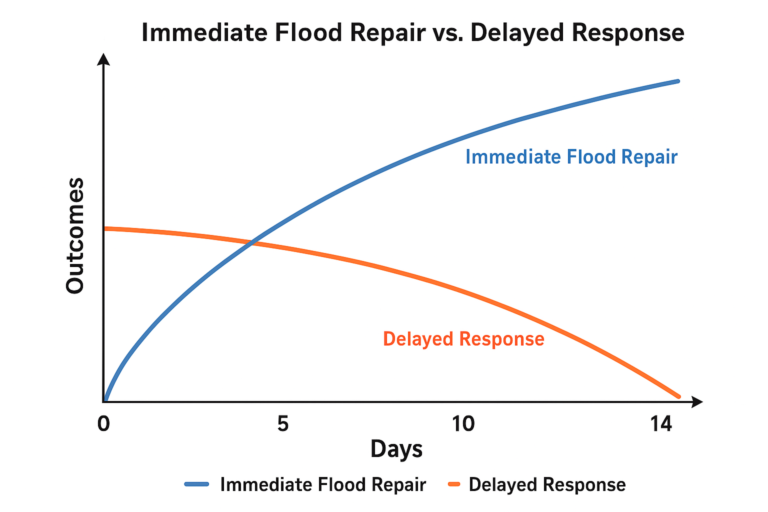
If flooding occurs, professional repair of the situation should not only be done as soon as possible but is really necessary. Fast reaction keeps water from going deep into the parts of the building made of wood or other materials, which can cause the appearance of mold, weakening of the building and very expensive damage to the structure of the building which can last for a long time. Among the emergency services, flood repair deals mostly with the work that focuses on the rapid extraction, drying, sanitization, and restoration to keep your home safe, sound, and habitable. By fixing the problem at the earliest stage, homeowners are free from the trouble of unnecessary repairs and go back to their normal lives very quickly.
Key Benefits of Emergency Flood Repair
- Stops mold before it spreads, reducing health risks and preventing widespread contamination.
- Protects the structural integrity of walls, floors, and support systems.
- Reduces lingering odors and hidden contamination, ensuring a cleaner, healthier environment.
- Preserves flooring, drywall, and insulation, preventing complete material replacement.
- Lowers overall restoration costs by minimizing the extent of damage.
- Restores safety and comfort faster, allowing families to return to normal life sooner.
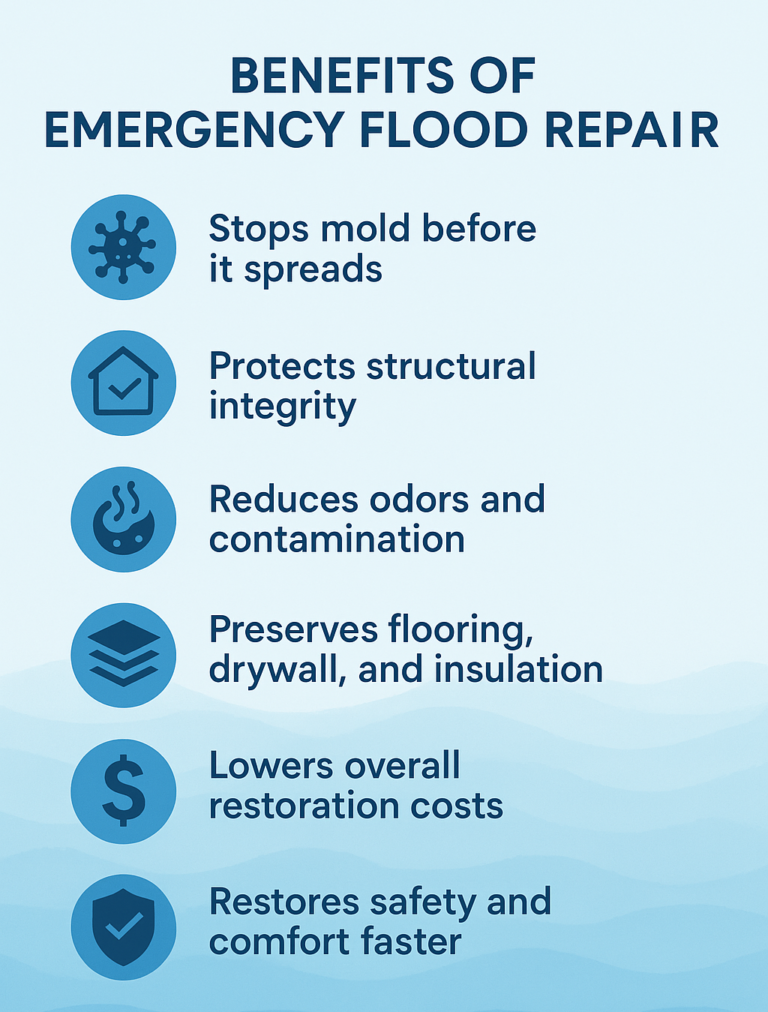
These benefits make immediate, professional repair essential after any flood event.
Safeguarding Your Property Against Hidden Damage
At the end of the day, emergency flood repair should not just be seen as a mere cleanup operation. It is actually a carefully planned strategy that safeguards your house against the development of mold, rotting, and rising repair expenses. By involving the problem at the source and getting rid of the water, the structure is saved and the whole place is obviously going to be a safer place to stay in the future. Your home is essentially shielded from the devastating side of the flood, and returns to its normal state much quicker than it is anticipated, when accurate drying and modern restoration methods are employed properly.
 Loading...